Statement ON THE 2004 SELECTION OF A NEW UP PRESIDENT
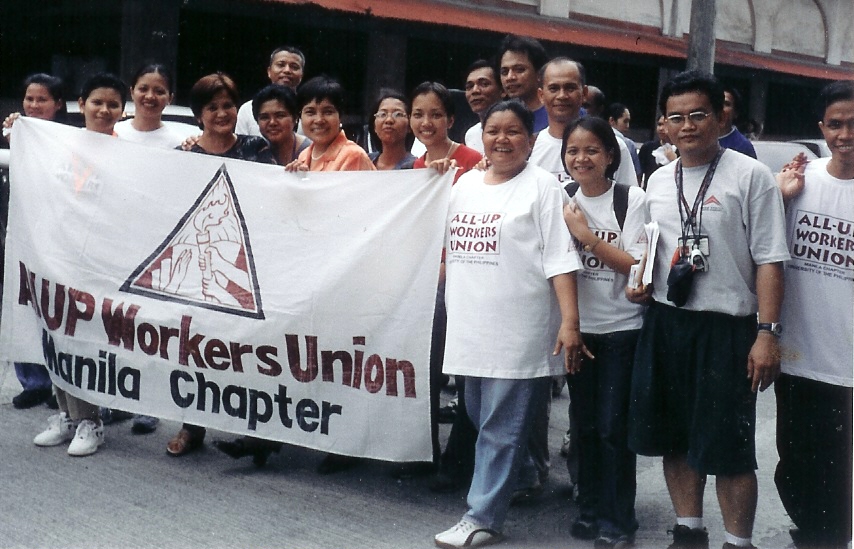
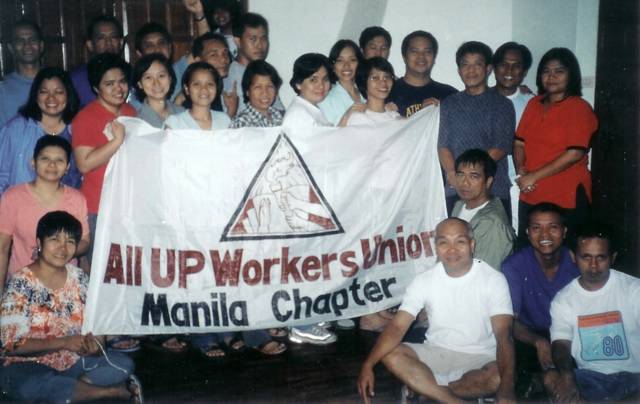
ALL UP WORKERS UNION and ALL UP ACADEMIC EMPLOYEES UNION
September 14, 2004
The University of the Philippines is now in the midst of a selection process for a new President. There are 11 nominees to the UP Presidency new UP President will preside in the commemoration of the centennial of UP in 2008.
In 1999, the All UP Workers Union issued the following statement during the search for the UP President who would replace President Emil Javier:
“Officers and members of the All-UP Workers Union have been asked to support this or that candidate. As an organization, the All UP Workers Union does not support any particular candidate. This is due to several reasons.
The selection process remains undemocratic. Under a process of selection which leaves to the Board of Regents the final decision on who would serve as the president of the university in the coming six years, the direct participation of the All UP Workers Union and other sectors of the university is at best only a form of tokenism. We have witnessed in the past selection of the UP president that even with a semblance of participation of the faculty, REPS, administrative employees and students in the form of straw polls, balloting, or show of hands, the popular choice, if he or she was not the choice of Malacanang, was easily disregarded by justifications that the leadership of an academic institution is not a popularity contest. Even this concession to a show of participation has been removed with the elimination of the straw polls, balloting or show of hands, as a key consideration for the selection. It is not surprising then, that the efforts of generating “popular support” for a particular candidate is aimed at influencing members of the Board of Regents or the President of the Philippines, who eventually has the final say in the selection. In the end, the UP President is accountable not to the majority of the university’s constituency but to a handful of people, and especially to the President of the Philippines who has the power to appoint the majority of the members of the Board of Regents. Therefore, the direct participation of the All-UP Workers Union as an organization, would merely mean an exercise in futility or worse, a means to provide legitimacy to a flawed and basically undemocratic process.
The All-UP Workers Union remains consistent in its criteria for the selection of officers of the university. The union as an organization of faculty, REPS, and administrative staff of the university, is committed to advancing the welfare and democratic rights of all employees of the UP and in supporting the just demands of the students and community residents of the university. The union recognizes that the situation and problems of UP employees cannot be divorced from the situation and problems of other government employees and identifies itself with the struggle of the rest of the citizens of the country. It takes to heart the vision of a university that is truly in the service of the Filipino people. Consequently, the union, in previous selection processes of university officials, whether they be chancellors, faculty regents or deans of academic units, has opted to come out with a set of criteria by which candidates for the position may be evaluated prior and even after their selection.
The All-UP Workers Union seeks a UP president who:
- Is committed to improving the welfare of university employees.
- Believes in the democratization of the university and supports efforts of the university constituency to exercise their democratic rights including the right of the faculty, REPS and administrative employees to form and maintain their unions and associations.
- Opposes the commercialization and privatization of the university in whatever forms and guises as these violate the basic character of the UP as a safe university.
- Resists all forms of foreign intervention, whether in the curriculum or in national affairs, that put at risk the autonomy of the university and the sovereignty of the country.”
The selection process for the search of a UP President for 2005-2011 has not essentially changed from the one conducted in 1999. However, in the present context of the continuing attack against state support for social services including education and health; the faster pace of commercialization of the University; the ongoing reign of an anti-democratic chancellor in UP Los Banos; the obstacles to the implementation of salient provisions of the Collective Negotiation Agreement and the struggle for a new UP Charter in Congress, the All UP Workers Union and the All UP Academic Employees Union forward the following specific and additional criteria for the UP President we would support:
- A UP President who will support a democratic governance structure for the University and explicitly oppose the commercialization and privatization of UP as contained in HB 2327 or the UP Charter of 2004
- A UP President who will fight for a bigger budget for education and health and for a moratorium in the automatic appropriations for debt payments in the national budget
- A UP President who will implement the provisions on additional economic benefits contained in the Collective Negotiation Agreement between the UP Administration and the All UP Workers Union signed in April 2002;
- A UP President who will support the payment of the back COLA of UP employees
- A UP President who will not tolerate, oppose anti-democratic actions of university officials, and will seriously investigate charges against high ranking UP Officials; such as the charges against the current UP Los Banos Chancellor
===================
UP Presidency Selection
The eleven who accepted the nominations for UP President are:
- Dr. Consolacion Alaras, former Chair of the Department of English and Comparative Literature,College of Arts and Letters, UP Diliman
- Dr. Soledad Cagampang-De Castro, former faculty, UP College of Law
- Dr. Ernesto De Castro, Acting Chancellor, UE Caloocan Campus
- Dr. Georgina Encanto, former Dean, College of Mass Communication, UP Diliman
- Ambassador Edgardo Espiritu, Ambassador Extraordinary and Plenipotentiary to the United Kingdom of Great Britain and Northern Ireland, Republic of Ireland and Iceland, and former member, UP Board of Regents
- Dr. Ester Garcia, former Chair, Commission on Higher Education and former Professor of Chemistry, UP Diliman
- Dr. Federico Macaranas, Executive Director, Asian Institute of Management-World Bank Development Resource Center
- Prof. Solita Monsod, Professor of Economics, UP Diliman andformer Philippine Socio-Economic Planning Minister (later Secretary)
- Dr. Emerlinda Roman, Chancellor, UP Diliman
- Regent Abraham Sarmiento, former Associate Justice, Supreme Court of the Philippines, currently member of the UP Board of Regents
- Dr. Eduardo Sison, Chairman of the MADECOR Group, a consulting firm based in the Philippines and former faculty, UPLB Institute of Food Science and Technology
Revised Schedule
- UP Baguio, Friday, September 10, 2004; 10 am
- UP Visayas (Iloilo), Wednesday, September 15, 2004; 10 am
- UP Cebu, Thursday, September 16, 2004; 9 am
- UP Mindanao, Friday, September 17, 2004; 10 am
- UP Manila, Monday, September 20, 2004; 9 am
- UP Los Baños and UP Open University, Thursday, September 23, 2004; 1 pm
- UP Diliman, Monday, September 27, 2004; 2 pm
Attendance of the nominees in the public fora is optional; non-appearance in the fora shall not disqualify a nominee. Members of the UP community who will attend a public forum shall be requested to submit written questions before the start of the public forum. The Board has requested the Chancellors to help solicit questions from different sectors. The source of the question shall not be identified during the forum. Only written questions shall be entertained by a panel consisting of the regents present, the Chancellor or his/her representative and the ALL-UP Workers' Union representative. One of the Regents shall chair the panel during the forum.
The criteria for the selection of the UP President (see Update #1) are repeated below to help you think of questions to ask.
- Stature in the academic profession, administrative capability, national and international reputation as a scholar, probity and moral integrity;
- Possesses the political will and the political skills to defend and promote academic freedom and institutional autonomy, commitment to academic excellence, a clear and inspiring vision of UP's role in the 21st century;
- Ability to raise funds without compromising the traditional values and ideals of academia, capacity to manage available resources to sustain the UP modernization program, fairness in dealing with all constituents; does not persecute or dispense special favors; does not engage in factionalism;
- Preserves the secular and non-sectarian character of UP, maintains and enriches intellectual diversity; does not promote a particular religion or school of thought, keeps UP above politics, but respects the rights of faculty members and students to participate in political debates and campaign for their beliefs within the limits of law.
The BOR is scheduled to interview the nominees during the period October 11-15, 2004.





 Posts
Posts

