Pages

Tuesday, August 23, 2011

Laborer’s son opts to stay, work in the Philippines


Even this year’s topnotcher in the board licensure exams for nurses agrees: “There are so many of us.”
But still, for Jomel Lapides, 21, this surplus can be turned into a strength—by making it more attractive for new nurses to work in the public health sector, especially in underserved areas in the countryside.
The construction worker’s son emerged No. 1 in the exams conducted in early July by the Professional Regulation Commission (PRC), where 37,513 examinees made the cut out of 78,135. Lapides, who graduated cum laude from the University of the Philippines Manila, topscored with a rating of 88.4 percent.
The achievement, while bringing untold joy to his family who lives in a relocation site in Rodriguez, Rizal province, ushers him into a profession once considered to be a sure ticket to greener pastures abroad but is now overcrowded with the unemployed.
But in an interview a day after the PRC released the exam results, a euphoric and grateful Lapides sounded so sure that he could find his place—and it’s definitely not overseas.
“My family and friends are here,” he said when asked about his job-hunting plans.
Currently earning his pocket money working as a math and science tutor, Lapides said his immediate plan after getting his license would be to apply at state-run Philippine General Hospital (PGH), where he looked after mostly indigent patients during his on-the-job training. “These are the people who really need help,” he said.
A “simple guy” who enjoys reading textbooks and other materials even during the summer break or well in advance before his teachers called for it, Lapides said he had not given much thought to seeking more lucrative employment abroad.
“I’m content with what we have,” he told the Inquirer in an interview on Sunday at the family’s home, an unfinished one-story, two-room affair shared with five people, with a technicolor clothesline dominating the facade, and whose only remarkable piece of furniture was a tall bookshelf containing some 50 nursing books.
Motivation
For as long as his family would have enough to get by, Lapides said, getting a fat paycheck may not necessarily be his motivation and priority.
“[My classmates and I] were exposed to public hospitals and different communities,” Lapides recalled. “Though there are many hospitals, poor patients from the provinces still have to go to PGH (to afford the treatment).”
Lapides agreed with government assessments that the country, after banking on a high demand for nurses abroad, had ended up producing an oversupply of nursing graduates.
As early as 2006, the Philippine Nurses Association said demand for nurses in the United States and UnitedKingdom, for example, had plunged.
Health Secretary Enrique Ona has also been advising incoming college students to stay out of nursing since more than 200,000 nursing graduates are currently out of work.
Wasted investments
“I agree with the move to cut down the number of nursing schools,” Lapides said. “The students’ investments just get wasted because of lack of job openings. And even if they pass the board exams, if their schools don’t have a good performance record, it would be difficult for them to find employment.”
But he also saw the irony of it all: There are still so many far-flung communities in the country in need of basic health services, so “why not send us to serve there? There are so many of us.”
The UP alumnus also asked the government to look into hospitals that reportedly ask licensed nurses to still pay for their “training.”
“They are qualified and are serving their duty. Why do they have to pay for it?” he wondered aloud.
Tough questions from someone who actually planned to take up civil engineering—not nursing—when he took the UP admission tests. Lack of confidence at the time, he said, made him write down nursing as his “first choice” and engineering as only his second.
By his third year in nursing school, Lapides could already switch to engineering, having met all the requirements. But then he had already grown to love the course and his supportive “batch mates” in UP.
Text ‘joke’
He said he and his batch mates made the otherwise tough course easier by organizing study groups as the board exams drew near.
They had become such a lighthearted but closely knit bunch, Lapides said, that before he personally got confirmation that he topped the tests, his batch mates were already texting him about his feat.
And yet he still laughed it off as just another prank, he said, chuckling. His initial reaction was: “Sabay-sabay nila akong pinagti-tripan (They were all playing a joke on me).”
But the joke turned out to be for real. His summer readings and study group sessions had paid off, and Lapides can now celebrate not only his success but that of his fellow nursing board passers from UP Manila.
“I’m so proud of all of us,” he said, referring to the other 56 examinees from UP, all of whom passed the 2011 exams.
Laborer’s son opts to stay, work in the Philippines
Philippine Daily Inquirer, August 23, 2011

UP topnotcher wore red underwear


For a promising man of science, the topnotcher in this year’s medical board exams is quite superstitious.
“I wore red underwear and ate a Red Ribbon empanada,” Mark Augustine Saquido Onglao said, sharing what he held to be his lucky charms on the day he took the tests early this month.
“I also did not cut my hair or shave during the entire review,” added Onglao, who can finally take it easy—and visit the barber shop.
A graduate of the University of the Philippines Manila, Onglao earned a rating of 88.42 percent to lead the 1,605 passers out of the 2,131 examinees, according to the Professional Regulation Commission which released the examination results last week.
On a more serious note, the 25-year-old Onglao said he would be applying at state-run Philippine General Hospital and hopefully join its team of surgeons.
“It is not just about money but the people and their lives,” he said of his decision to work for a hospital that caters to the poor.
“For me, it is more gratifying to treat our fellow Filipinos than go abroad and serve other nationalities. It feels good to practice medicine here where we are needed,” he told the Inquirer on the phone on Monday.
Onglao said several other board passers from his batch in UP Manila also plan to work in the country rather than seek employment abroad.
“Perhaps we have become aware of the brain drain and the lack of doctors and facilities in the country. We all want to help change this,” he explained.
Payback
It’s also about paying back: Onglao was a recipient of the UP Oblation Scholarship—a grant given to the top 50 passers of the UP College Admissions Test (Upcat). He also earned another scholarship from the Office of the UP President.
Onglao finished high school at Xavier School in Greenhills, San Juan City. While his father, who ran a computer business, managed to provide for “our big family” that included eight children, “the scholarships really helped me a lot,” he said.
For Onglao, a doctor need not work in the countryside to be “community-oriented.”
He said he was taught at the UP College of Medicine that “whether a doctor is working for a private or public hospital, he or she should always think of how he can best help the patients and their communities.”
News of him topping the board exams came as a surprise, in a flood of congratulatory messages he received while he was hearing Mass.
“I was shocked and in disbelief initially. I even asked the one sitting next to me (in church): ‘Is this a joke?’” he said. “Eventually, the news sank in. I just felt blessed and thankful to God and to those who prayed for me.”
Not first time
“I just wished to pass the board exams. At UP, there were a lot of brilliant students and all of us had prepared for it,” he said.
“Mac” said it was not the first time he performed the “red underwear” and no-haircut rituals in preparation for big exams.
Since his high school days, he said, these superstitions had been a personal routine, “probably like what athletes do” before a crucial game.
According to him, one should never cut his hair and fingernails before an exam lest he forget everything he has reviewed.
Wearing red underwear and eating empanada, meanwhile, attract good luck, Onglao further deadpanned.
Has it worked for him all the time? “I think so,” said Onglao, who also graduated cum laude and salutatorian of his UP Manila class.
UP topnotcher wore red underwear
Philippine Daily Inquirer, August 23, 2011

Monday, August 22, 2011

Proposed 2012 National Health Budget: A perpetuation of government’s neglect on people’s health and welfare of health workers

Press Statement
August 20, 2011

Reference:

MR. JOSSEL I. EBESATE. RN

National President, Alliance of Health Workers
Mobile Phone: 09189276381

The 2012 proposed budget for health increased by 31.7% from P32.427B in 2011 to P42.693B. However, this deceptive increase is not intended to improve public health services or make public hospitals relevant and accessible to poor patients.


The purported increase goes only on the P12.028B allocation for Philhealth subsidy to the poorest 5.2 million families (20% of the population) and P3B for national government counterpart for PPP projects to be implemented on government hospitals starting next year. Minus the P3.5B allocated for Philhealth subsidy for this year (2011), the health budget actually went down by 5% or P152M.


The Philhealth subsidy for the lowest 20% of the population negates the fact that 80% of our people relied on public health facilities for their health needs. Thus, leaving the next 60% of our people vulnerable to the increased health services that will result in the privatization of health services brought about by the PPP projects in public hospitals.  The supposed “zero balance billing” for the 22 most common ailments that will be started this September, covers only the poorest 20% of our people, leaving even those in the formal labor sector (and supposedly covered by Philhealth) to absorb the increased hospitalization cost, in excess of the Philhealth capitation.  Furthermore, it is a fact that Philhealth capitation covers only about 30% of the total health care costs.


It also failed to provide additional plantilla positions for public health care facilities in spite of admission from the DOH Secretary himself that public hospitals are understaffed by 300% for nurses alone (1:30 nurse-patient ratio in stead of the ideal 1:10 ratio).  The 12,000 nurses for 2012 under the RN HEALS program is only an annual (sic - temporary/contractual) employment opportunity, and a " drop in the bucket" compared to the more than 300,000 unemployed or mis-employed registered nurses.  The RN HEALS program is also a form of exploitation of our health professionals, comparable to the "volunteer with fees" in hospitals, because nurses under the said program only received P8,000.00 as monthly renumeration, compared to P17,099.00 starting monthly salary for regular government nurses. 


The proposed 2012 national budget further decreased by P3M, the allocation for Magna Carta benefits for public health workers from P714M to P711M; instead of increasing it by P1.5B - to include all public health workers at the DedEd, hospitals under the DOH, and other agencies such as PGH and UP Manila (with P250M shortfall).  Ever since the enactment of the law (RA 7305) in 1992, the national government failed to allocate funds for these benefits; thus, hospitals under the DOH have been sourcing their Magna Carta benefits from savings and internally generated funds.


Finally, by centralizing the capital outlay of public hospitals under the DOH (through the Facilities Enhancement Program) (P5.078B) at the DOH Central Office; and all unfilled positions in the government (P23.427B) at the DBM, the Pnoy government only perpetuated the lump-sum appropriations practiced by the previous administration, which have been proven to be the source of large scale corruption.#


Tuesday, July 26, 2011

166 Contractual Workers Summarily Dismissed by DOH Seek “Justice”

PRESS RELEASE:
July 25, 2011

“Unjust, inhumane, morally degrading,” these were the general sentiments of 166 Job Order/Contractual Personnel summarily dismissed last June 30, 2011 by the DOH central office from further undertaking the health program Maternal, Newborn and Child Health and Nutrition (MNCHN) under the National Center for Disease Prevention and Control (NCDPC).  Among them were 75 registered nurses that comprise 46% of the total project workforce.

As per the account of  “Mark”, one of the field nurses, they learned of their termination late afternoon of June 30, 2011, from Ms. Vivencia Martinez, NCDPC Administrative officer who instructed 166 of them  not to report for work anymore effective the following day Friday, July 1, 2011 because, according to her, NCDPC  Director IV Dr. Lilibeth David said their Contracts have already ended. Then, at exactly 5 p.m. of the same day, a memo was posted signed by Dr. Kenneth Ronquillo, Director IV of the Health Human Resource Development Bureau (HHRDB) affirming said order with further advise for them to undergo a clearance process for the release of their last salary for service rendered between June 15 to 30, 2011.

“We were stunned and many were devastated of the sudden  and unexpected termination of our contracts.  Many of us nurses just arrived from an exhausting field work doing measles immunization where we really scoured the remotest villages to ensure that young children were given the measle shots.”

He said that the action of the present NCDPC management team under Dr. Lilibeth David was illegal if not questionable because the workers have already signed a contract for July-December 2011 under the former NCDPC head Director IV Dr. Eduardo C. Janairo prior to his transfer  to his current assignment at  Center for Health and Development-NCR.   The contract signing was done in May 2011 after a satisfactory job performance evaluation of the workers that served as basis for the renewal of their contracts from July to December, 2011.

Aggravating this “injustice” was the holding and non-release of the workers’ last salary and reimbursements of work-related expenses.  Not only were they not given due notice of their termination, they were also deprived of the salary that they have already worked for therefore rightfully theirs.

A petition signed by some of the terminated workers, including nurses, appealing for an immediate resolution of the case has been submitted to the Office of the Secretary, Dr. Enrique Ona; no response yet.  A complaint has also been filed with the Ombudsman and a letter was likewise submitted to the legal department of the Department of Health.

References:     MS. MARIS PRESTO-ABENOJAR, MAN, RN
Vice-President, NARS ng Bayan
cp : 09331827323 email: nars.philippines@yahoo.com

MR. MARK ALCARAZ DAQUIGAN, RN
cp: 09054307358

MR. JEOMAR BALAO-AS, RN
cp: 09395707858

Note:  All three were dismissed contractual nurses

MS. ELEANOR M. NOLASCO, RN
0915 513 6080; 0922 828 0928
President, NARS ng Bayan,
an association of Community Health Nurses and People’s Health Advocates


Sunday, July 24, 2011

PPPs in health threaten to make health care costlier – health workers - Bulatlat


Published on July 22, 2011


“You go to a public hospital emergency room to have your wound cleaned, you have to first buy some cotton, wound antiseptic, and dressings, before you can be treated,” said Joel Bitanga, 40, an X-ray technician in San Lazaro Hospital.

By MARYA SALAMAT
Bulatlat.com

Sidebar: Health workers blame Aquino’s PPPs for further crippling the Philippine Orthopedic Center

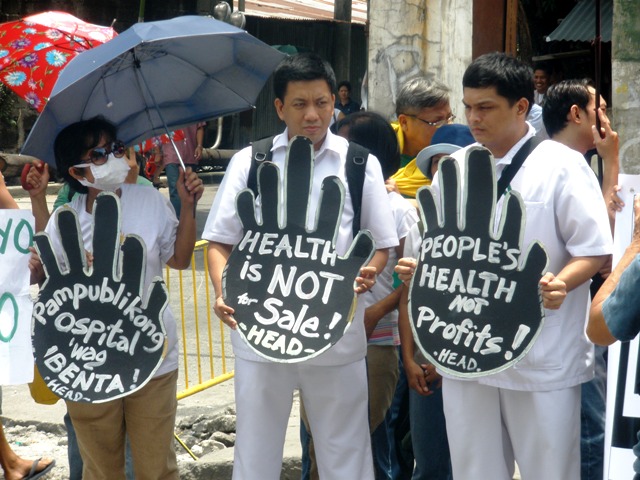
MANILA – After one year, healthcare in the country has gone from bad to worse — this is the assessment of the Alliance of Health Workers (AHW) on the Aquino government’s impact on health. In a series of protests held by its member unions in different public hospitals in Metro Manila, the group aired the various shocks of Aquino’s touted PPPs (public-private partnerships) on the services of public hospitals and the working condition of health workers and professionals in the country. The group challenged Aquino to stop the privatization “in any form” of public hospitals and to bail out public health by infusing it with a P90-billion ($2.09 billion) budget at least.


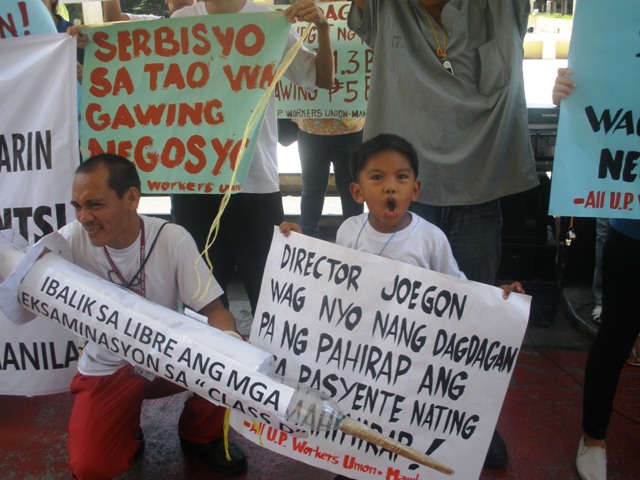
UP-PGH health workers urge their hospital management to revert to giving poorest charity patients free treatment. A mother brought out a child patient. (Photos by Marya Salamat / bulatlat.com)

During Aquino’s first year, the country’s main public hospital, the Philippine General Hospital (PGH), for example, has, for the first time in its history, resorted to charging fees even from its lowest ranked charity or indigent patients. In a memo issued last month, the PGH administration reportedly directed its hospital staff to charge the previously free diagnostic and laboratory examinations of “class D” patients. These are the patients who, according to the hospital social workers, belong to the lowest earners or the poorest of the poor among the four groups who qualify for “social service.” Class D used to receive full support (or full charity), while the other classes under social service get discounts, much like the socialized tuition fees being implemented in the University of the Philippines, explained Jossel Ebesate, AHW national president.

In the Philippine Orthopedic Center, fees have been drastically increased early this year, with some increasing more than twice its old amount.

Because of the budget cutbacks implemented by the Aquino administration in the budget for maintenance and other operating expenses of public hospitals, the previous shortages in medicines, supplies and other equipment have become worse, reported the AHW. The exacerbated shortage in turn prompted the administrations of public hospitals to increase fees and to charge fees on previously free items in the hospital menu of services.

“You go to a public hospital emergency room to have your wound cleaned, you have to first buy some cotton, wound antiseptic, and dressings, before you can be treated,” said Joel Bitanga, 40, an X-ray technician in San Lazaro Hospital. He added that if you were brought to their hospital and you can’t breathe, you have to buy the hose and other paraphernalia for your oxygen.


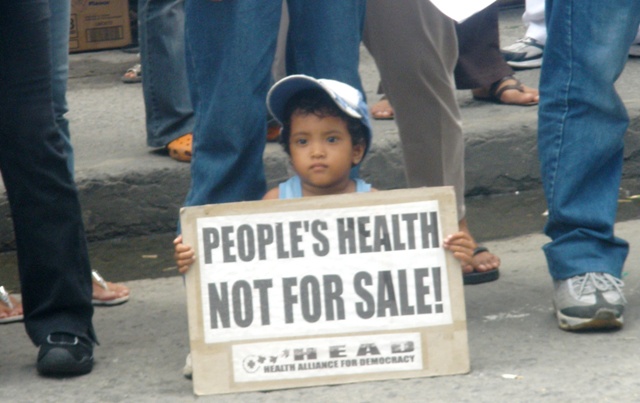
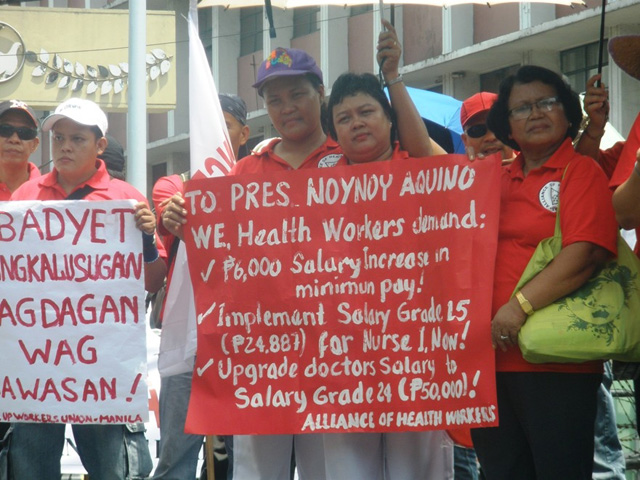
Health workers and a child urge the Aquino government to treat healthcare not as source of profit but as public service.(Photos by Marya Salamat / bulatlat.com)

Picketing in front of San Lazaro Hospital, then at Jose Reyes Memorial Medical Center and in front of the Department of Health, the health workers decried last Monday the increased fees also prevalent in the Philippine Heart Center, the Lung Center of the Philippines, the National Kidney and Transplant Institute (NKTI), the Philippine Children’s Medical Center (PCMC) and the East Avenue Center (EAMC). These are some of the hospitals retained by the national government after it implemented a devolution of health services in 1992.

The practice of charging and increasing fees which the majority of low-income Filipinos are already finding as tough, would likely worsen if the Aquino government pushes through with its planned PPPs targeting even government hospitals, the AHW warned.

Already, the health group noted that some private companies that were able to get concessions in public hospitals have been profiting from this public-private partnership. They cited as example Himex, which provides the radiology “services” of Jose Reyes Memorial Medical Center; the Carte-blance in Lung Center which profits from its dietary services; and Fabricare for Lung Center’s laundry. In PGH, the privately-operated Faculty Medical Arts Building has begun operations this year.

In public hospitals being operated by local government units, a measure of success is the increase in hospital income, which could be
had by adding “private” or “pay wards” and other services that charge fees. The biggest example, for having been the first to be declared as a corporatized hospital is the La Union Medical Center. Provincial hospitals are now trying to follow its example, after its local governments have sent their public hospitals’ directors and staff to “Lakbay Aral” (Study Travel) to learn from “successful” provincial public hospitals.

Up for starting new PPPs soon are the Philippine Orthopedic Center (POC), the San Lazaro Hospital and the Research Institute for Tropical Medicine (RITM). While the moves are seeking to improve and upgrade the said hospitals – something which the health workers’ union said they also wish to happen – they are decrying the fact that these have to be planned under a PPP setup. They urged the government instead to fund the needed development, rather than enter into partnerships with the private sector whose motives for entering health services are mainly for profit.


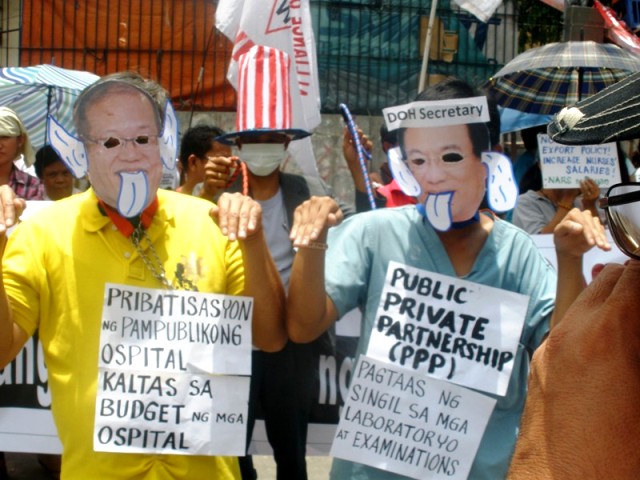
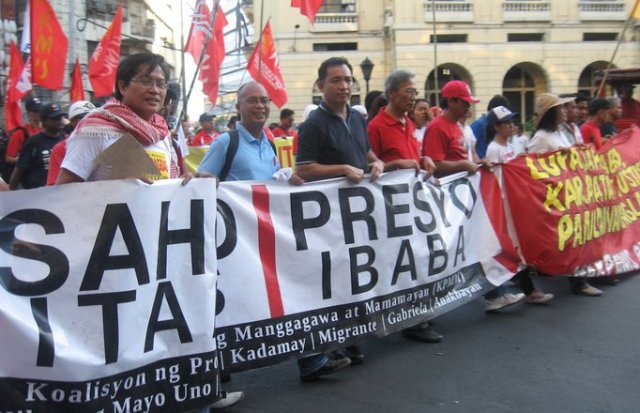
Health groups blame US imperialist dictates for Aquino’s drive to privatize and commercialize healthcare.(Photo by Marya Salamat / bulatlat.com)

“What will happen to our mentally ill patients? Will they be abandoned on the streets?” asked Arman Palaganas, vice-president of the health workers’ union in National Center for Mental Health. This mental hospital and the Philippine Heart Center are up for bidding in a public auction set to be held under the Aquino administration, the AHW reported.

When all these upcoming PPPs happen, the AHW warned, health care will become even less accessible to ordinary Filipinos.

Killing you softly

Given the frequently slashed budgets, health workers’ wages and benefits have also taken a beating. In fact, the Department of Budget and Management itself has told public hospital administrators and even local government units that benefits being given to health workers are contingent on the hospital’s savings or on the availability of funds. The result, according to AHW, is either lacking or almost nil benefits especially for health workers under the local government units.


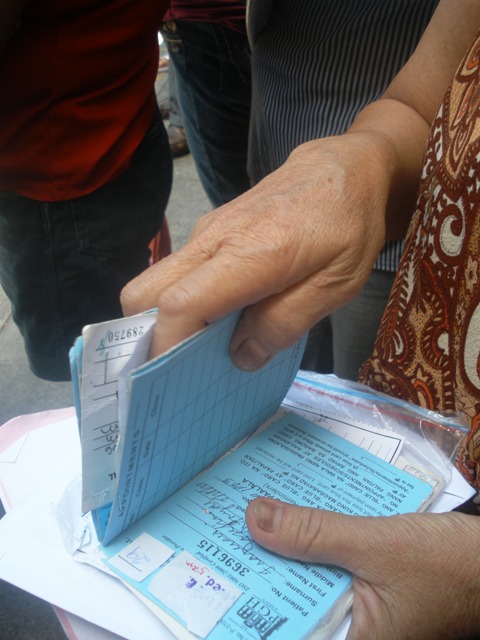
A PGH patient’s charity cards and papers attesting to her indigency could mean little now in terms of free or affordable treatment. (Photo by Marya Salamat / bulatlat.com)

For twenty years now, the country’s plantilla position for health workers and professionals have barely increased, despite the continued pressure of population increases. Worse, while the plantilla positions are being controlled, the AHW noted that the ranks of the country’s health workers are under attack and being reduced by bouts of retrenchment or streamlining through transfer, attrition and early retirement.

Instead of replacing the lost regular health workers, AHW noted that the government itself has been increasingly implementing “flexible labor arrangements,” a favorite under profit-oriented corporations. In the health sector, these arrangements range from contractualization, job-order employment (similar to project-based hiring), and the notorious “volunteerism” where the hospitals not only do not pay the health professionals who serve them but even make them pay for the “training” and “experience.”

As if to gag the health workers’ groups who have been criticizing and providing proofs of the government’s abandonment of its responsibility top ensure the people’s health, there are alleged moves from public hospital managements to bust the health workers’ unions, or else “deceive, divide and crush” the progressive unions under the Alliance of Health Workers. The AHW complained that the management of some public hospitals, such as the National Center for Mental Health, Jose Reyes Memorial Medical Center, Philippine Orthopedic Center and Philippine Children’s Medical Center, “do not recognize and even try to coerce the accredited sole bargaining unit.”

As such, judging from the way the government has been treating Filipinos as patients and as health workers, the health group charged that “the people has never been Aquino’s real ‘boss,’ as he had boasted, but the politicians, the local big landlords and the big local and foreign investors.”

The poor cannot survive under the Aquino government’s health agenda of privatization, the Health Alliance for Democracy said in a statement. The poor will get sicker and die sooner if the rate increases continued, said PGH nursing attendant Ellen Jamison in a picket protest in front of the PGH this week.

The health groups encourage health workers and the families of patients in public hospitals to join in protesting privatization and pushing for health as a human right. (http://bulatlat.com)

PPPs in health threaten to make health care costlier – health workers - Bulatlat

Sunday, May 15, 2011

Aquino’s ‘universal health care’ a sham — health workers

By MARYA SALAMAT
Bulatlat.com

Published on May 12, 201


MANILA— “Other people including graduates of ‘mere four-year-courses’ are earning higher salaries than me,” said a trained surgeon working for years now at a district hospital in a province north of Manila. He said that lack of doctors in their hospital has also forced him to work on “all kinds of cases and not just on an operating table.” Today, he admitted that he is applying for a job abroad. As a surgeon, he thought his career is also in danger here as a new regulation is “being cooked up” by the PRC (Professional Regulations Commission) in Manila requiring people like him to become member of a certain society of surgeons first, before he can renew his license.

Still, this doctor went to Manila and braved the scorching summer heat to join his colleagues from different hospitals and practices in commemorating the National Health Workers’ Day last May 7. The Health Workers’ Day main program peaked at high noon at the Mendiola Bridge.

Almost a year into Aquino’s presidency, health workers complained they “still suffer from low salaries, inadequate benefits and understaffing,” a plight some of them had thought would change under President Benigno “Noynoy” Aquino III. In his election campaign, Aquino was reputedly the only candidate who had promised to take care of public health. But today, a year into his presidency, a bigger allocation of the public purse has been going to militarization and debt servicing rather than public services such as health, said the health workers’ groups.

(Photo by Marya Salamat / bulatlat.com)
To finance health, Aquino increasingly turns to PPPs (public-private partnerships), which, the health workers’ groups said, are treating health services as “profitable” ventures rather than public services. They said the PPPs make health services available but costly to average Filipinos.

An elderly public hospital employee who went on leave to join her fellow health workers in their nationwide protest told Bulatlat.com they had “really believed things would be different with Aquino. But here we are again,” she said, “asking for the same things.”

In commemorating the National Health Workers’ Day last May 7, health workers held a protest caravan from the Lung Center of the Philippines, early morning, stopped for a brief program in front of the University of Sto.Tomas in España, then proceeded by midday to their main program at the Mendiola Bridge near Malacañang. The health workers are demanding a salary increase of P6,000 ($139.75) per month. The Alliance of Health Workers (AHW) said they conducted the Health Workers Day protest also to “continue the fight for jobs, rights and health of the people.”

Tuesday, May 10, 2011

Government employees expose Malacañang’s ‘fake salary hike announcement - Bulatlat

By INA ALLECO R. SILVERIO
Bulatlat.com

Empty lies and pure rhetoric.

According to the Confederation for Unity, Advancement and Recognition of Government Employees (COURAGE) , these are what comprise Malacañang’s post-Labor Day announcement. On May 1, Palace spokespersons said that President Benigno Aquino III has approved a salary adjustment for government workers and that it will be released in June.

Courage president Ferdinand Gaite said the announcement was meant to enhance President Aquino’s image in the eyes of state workers, many of whom have been steadily becoming disillusioned with his administration and its failure to implement significant economic reforms.

According to Gaite, the Aquino administration was trying to fool the public with its announcement.

“Malacañang claimed that administration officials, together with the Department of Budget and Management (DBM) and the president pulled strings just so employee’s demand for a wage hike can be made possible. This is a lie,” he said.

Gaite said that what Malacañang did is to fast-track the implementation of the third tranche of Salary Standardization Law 3 (SSL 3), originally set to be released in July.

Courage president Ferdinand Gaite joins the Labor Day rally.(Photo by Ina Alleco R. Silverio/ bulatlat.com)

“Employees have nothing to look forward to because even before we receive our ‘adjusted’ salaries. The real value of the amount has already been eroded by inflation. Most rank-and-file employees have already committed it to pay their debts,” said Gaite.

The union leader said the second tranche of the SSL 3, the law mandating the staggered pay adjustment scheme passed during the Arroyo Administration, was also released in June last year.

“There’s absolutely nothing for Malacañang to brag about, and even more certain is the fact that government employees have nothing to thank President Aquino for,” he said.

Gaite said that for the country’s rank-and-file government employees who are already struggling to survive amid the rising costs of commodities, the issue is already beyond the SSL 3.He said that only President Aquino and top government officials with enormous pay hikes have benefitted and continue to benefit from the SSL 3.

“As for the rest of us, for the lower-salary grade employees and minimum wage earners subsist on meager wages, the SSL 3 is useless. Even with the full implementation of SSL 3 next year in 2012, the minimum pay will still only amount to P 9, 000 (US$209), way below the government’s estimated average Family Living Wage (FLW) pegged at P29, 640 (US$689.30) per month. We stand by our demand for a P6,000 (US$140) increase to the minimum pay of all government employees.,” Gaite insisted.


Government employees expose Malacañang’s ‘fake salary hike announcement - Bulatlat

Thursday, April 28, 2011

BusinessWorld Online Edition | May Day distress call

No one -- not even employers or the government -- will dispute the sad state of Philippine labor today. The figures do not lie or dissemble. And yet year in and year out, government and employers merely raise their hands and feign helplessness over the situation. They repeat the same old line: wage increases would result in inflation, causing greater woes for workers including the threat of losing their jobs, since higher wages could result in their employers going bankrupt.

What are hidden from view are the huge profits raked in by foreign and local corporations in stark contrast to workers’ starvation wages.

Preliminary results of the 2008 Annual Survey of Philippine Business and Industry (ASPBI) of the National Statistics Office (NSO) as cited by IBON Foundation, show that establishments in the country with total employment of 20 and over had combined profits of P895.2 billion and 2.74 million employees.

Even more revealing, the Top 1,000 corporations in the country reaped a cumulative annual net income of P3,788.9 billion over the period 2001-2009.

According to IBON, an across-the-board wage hike of P125 means workers will receive an additional P3,802 per month. Employers will spend an additional P49,427 per employee per year (assuming 13 months of pay). The total cost of the proposed wage hike will only be P135.6 billion which, subtracted from total profits, will still leave establishments with P759.6 billion in profits.

The P125 across-the-board increase called for by the Kilusang Mayo Uno will only cut employers’ profit margins by 15%. Assuming employers will not pass on to consumers any legislated minimum wage increase, there will be no significant inflationary effect. Because their enterprises continue to be profitable, there is no reason for them to close shop.

Consider that the average daily basic pay that wage and salary workers in the country actually received -- as opposed to merely mandated minimum wages that are not necessarily actually paid -- increased from P222 in 2001 to a measly P301 in 2010 (NSO Labor Force Survey, April 2010). The minimum daily wage of P404 in the National Capital Region is not even half of the estimated average family living wage (FLW) of P988 as of March 2011.

A large wage hike will be beneficial not just for workers and their families but also the economy, IBON added. The transfer of money from rich to poor households will increase aggregate demand and stimulate the economy...

BusinessWorld Online Edition |MayDay distress call

Saturday, April 23, 2011

Filipino Workers' victories and struggles celebrated in NY as May Day nears

Philippine Forum-NewYork/
http://nafconusa.org
NEWS RELEASE
21 April 2011

Reference: Anne Beryl Corotan; National Chairperson of NAFCON Youth Alliance, SANDIWA
Contact Info: sandiwa.national@gmail.com, info@nafconusa.org, (718) 5658862


NEW YORK -- On March 30, 2011, the "Justice for Sentosa 27++ Nurses" campaign has reached another milestone. US District Judge Joseph Bianco allowed a civil rights lawsuit to proceed against defendants Suffolk District Attorney Thomas Spota, his top assistant Leonardo Lato and the Sentosa Care nursing home firm. The suit states that defendants conspired to prosecute in retaliation for the mass resignation of the nurses from Sentosa Care last 2007. This decision puts more armor as the nurses and Atty. Felix Vinluan, the lawyer who was charged of conspiracy with the nurses, stride forward in struggling for justice and victory.

“I am happy with the recent developments. This is what we've hoped for in the first place but at the same time I can’t help feel a tinge of fear -- fear of the unknown and uncertainty. I do, however, console myself that we've always had truth as our guide and a myriad of support system as our shield,” says Archiel Buagas, one of the former nurses of Sentosa Care.

The Sentosa Nurses' Saga


The story unfolds in 2006 when the Sentosa 27++ (26 nurses and 1 physical therapist, and more healthworkers came out after) held a massive resignation from their health care facilities in protest of contract violations that Sentosa recruitment agency has committed against them. In retaliation, the Sentosa agency filed administrative and criminal charges, such as patient endangerment, against the health workers. Sentosa agency also charged Atty. Felix Vinluan with conspiracy for allegedly advising them on the resignation.

In 2007, the full blown campaign, "Justice for Sentosa 27++", spearheaded by the health workers, Atty. Vinluan and the National Alliance for Filipino Concerns (NAFCON), garnered support from all over the United States, in the Philippines and in a global scale. The strong collective strength, support and work of the community, various organizations and the bond between the healthworkers forged the way into sharply bringing attention to the case and the campaign.

"From the start, we, in NAFCON, have always believed that the nurses and Atty. Vinluan will win this fight. It may have taken years and a lot of strength and courage from the nurses and Atty. Vinluan to carry on with the big fight against this big company with its big political backers. But with collective action within the community, we have succeeded not just in achieving these gradual victories, but also in bringing awareness to the public that these kinds of abuses happen to our fellow Filipino migrant workers and that there are institutions which must be held accountable," states Jonna Baldres, Community Action Director for Philippine Forum-New York and NAFCON-US North East Coordinator.

On January 13, 2009, the Appellate Division of the New York Supreme Court, Second Department issued a writ prohibiting the criminal prosecution as it violates the nurses’ 13th Amendment right against involuntary servitude and Vinluan’s 1st Amendment right to free speech. It was at this time that the campaign of Sentosa 27++ was relaunched to “up the ante”.

On May 20, 2010, the New York Supreme court through Judge Stephen A. Bucaria denied Sentosa Care’s motion for summary judgment in the breach of contract case against the health workers. The court at this time also invalidated the enforceability of Sentosa Care’s claim for liquidated damages of $25,000.00 upon employee’s termination of the contract.

Victory for the Sentosa 27++ but the fight continues

These back to back victories, leading up to the most recent, were made possible by collective actions, committed support and unyielding passion to struggle for truth and justice. The fight has claimed victories but for the health workers, Atty. Vinluan, and the community, the fight is still far from over.

"The case of the Sentosa nurses is just a start. We have Leticia Moratal, Jacqueline Aguirre, Arizona 34 and hundreds more who have come out to give voice to the abused and trafficked migrant workers. And we will continue to fight and we believe we will win these struggles eventually as the community rallies behind us. We have seen it with the case of the Sentosa nurses, we believe we will witness more victories with the cases of the other trafficked victims," said Atty. Vinluan.

At present, NAFCON is handling more than a hundred cases of labor trafficking nationwide through its Stop Trafficking Our People (STOP) Campaign. Victims of Philippine-based recruitment agencies have come to the United States mostly on H2B visas, were promised certain provisions by the employers but were moved somewhere else and ended up working on different and inhumane conditions. With the neglect of employers and not having been given proper assistance by the Philippine government, the workers are oftentimes forced to deal with loss of status, making them more vulnerable and subject to criminalization by state forces.

"As long as the Labor Export Program (LEP) -- the policy of the Philippine government of sending away its people to other countries for profit -- is in effect, these types of abuses, such as what happened to the Sentosa nurses and the other trafficked victims, will persist. The current Philippine administration under President Aquino promised to increase jobs at home, and increase aid to Overseas Filipino Workers (OFWs) abroad. The challenge still remains until fruition is seen. We, in NAFCON, join the people in demanding from the Philippine government the generation of domestic jobs by pursuing genuine agrarian reforms and development of national industries so that the citizenry are no longer forced to decide and leave the country," states Baldres.

Call to rise up and speak out on May Day

Today, OFWs still suffer from worsening work conditions, abuse and government neglect. In its commitment to fight for workers' rights, NAFCON calls on all members of the community to stand up and let their voices be heard.

On April 24, member organizations of NAFCON such as Kabalikat Domestic Workers' Support Network and Philippine Forum, among others, will be marching for labor and human rights with the Independent Workers Movement and other migrant workers organizations. The march will start at the Bayanihan Filipino Community Center (40-21 69th St Woodside, NY) at 12nn.

“NAFCON is firmly committed to protect the rights and welfare of our kababayans in the United States. We will continue to fight until all demands are achieved. We demand Justice for Sentosa 27++. We demand to STOP trafficking our people. We demand an end to LEP. We demand legalization for all. We want justice for all migrant workers,” firmly positioned by Baldres.

On May 1st for the International Workers' May Day, together with the May 1st Coalition and other migrant and labor organizations and unions, we will march to stand up for workers and im/migrants' rights. Program will start 12nn at Union Square.

“It is the truth, we are the masses, we are the grassroots and we are the common. We blend in because we are one. Those in power are only as good as those that lift them up. We are their life source but oftentimes, they forget that the lowliest of us can also be their greatest strength. People need not live in shadows anymore, they have the option of speaking out and making things better for others. We might not see the effects now but I’m hoping in the near future, the lives of future workers and immigrants will be better because we insisted our voices be heard,” Buagas ended. ####

--------------------

The National Alliance for Filipino Concerns [NAFCON] is a national multi-issue alliance of Filipino organizations and individuals in the United States serving to protect the rights and welfare of Filipinos by fighting for social, economic, and racial justice and equality. It was launched in San Jose California in 2003. At present, NAFCON member organizations encompass over 23 cities in the United States.

Please visit nafconusa.org for more information on NAFCON and its campaigns. To join the NAFCON news list, please send a request to info@nafconusa.org.

Bulatlat » Independent Think Tanks Refute Malacañang’s Arguments Against P6,000 and P125 Salary, Wage hikes

“Since July 2010, skyrocketing commodity prices coupled with stagnant wages have eroded workers’ wages in lightning speed, which is unmatched by the previous administration,” said EILER executive director Anna Leah Escresa.

By INA ALLECO R. SILVERIO
Bulatlat.com

As Malacañang thumbs down the demand of government employees in the country for a substantial wage increase, research groups have taken turns debunking government claims that salary and wage hikes are impossible to implement given the current economic conditions.

Current Wage Provides Only 41 Percent of What Families Need

The IBON Foundation said the value of the daily minimum wage in Metro Manila has dropped and is only able to provide for about 41 percent of the amount needed for a family to live decently. This is less than the figure 10 years ago, in 2001, wherein the minimum wage was about 52 percent of the cost to live decently.

According to the IBON Foundation, the daily minimum wage of P404 (US$9.39) is just 2/5 of the estimated average family living wage (FLW) of P988 (US$23) in the National Capital Region (NCR) as of March 2011. The family living wage is defined as the minimum amount needed for a family of six members to meet their daily food and non-food needs plus a 10 percent allocation for savings. The latest living wage estimates are based on the 2008 family living wage computation of the National Wages and Productivity Commission of the Department of Labor and Employment (DOLE).

According to IBON data, the daily minimum wage of P265 (US$6) in 2001 was half of the amount a family needed to live decently, which was then pegged at P509 (US$12).

As the DOLE and the wage boards deliberate on whether to give a wage hike next month, the research group urged government to raise wages to a decent level and approximate the wage increase to the estimated family living wage.

Nonstop Price Hikes

Adding to the urgency of a wage increase, a labor research group said, is the fact that the combined wage increases in the past decade had been totally eroded within only eight months by nonstop price hikes under the Aquino administration.

The Ecumenical Institute for Labor Education and Research (EILER) said that from the start of Aquino’s term in July 2010 up to February this year, the real value of the P404 (US$9.39) minimum wage in the National Capital dropped by around P7 (US$0.16) This decline cancels out the net increase in the real value of minimum wage under the Arroyo administration from 2001 to 2010, which amounted to only P5 (US$0.11).

EILER’s computation is inflation-adjusted using 2000 as base year.
“President Aquino has just dethroned former president Arroyo, beating her record as the worst ‘eater’ of workers’ wages. Since July 2010, skyrocketing commodity prices coupled with stagnant wages have eroded workers’ wages in lightning speed, which is unmatched by the previous administration,” said EILER executive director Anna Leah Escresa.

She said that the wage erosion comes as no surprise as local pump prices have increased more than ten times since the start of year while the prices of almost all food commodities have also risen.

” There are also looming power and water rate hikes. Such record erosion of wages points to the government’s callousness in calling on Filipinos to wait for the inflation to reach five percent before the government can approve any wage increase,” Escresa said.

Government Should Take Care of its Employees

In the meantime, labor groups are determined to press for their economic demands no matter what Malacañang says.

The Confederation for Unity, Recognition and Advancement of Government Employees (COURAGE) said that it would continue their campaign for a P6,000 ($138) increase in the monthly minimum pay of all public sector employees.

“True to its character, the Aquino administration is skirting the issue by saying that its hands are tied because of the Salary Standardization Law 3 which mandates a staggered wage adjustment scheme for state workers. For the country’s rank-and-file government employees who are already struggling to survive amid the rising costs of commodities, the issue is already beyond the SSL 3. We all know that it allowed only the smallest pay adjustments and failed to provide immediate economic relief to the lowest-paid government employees. We will continue to press for a P6,000 salary hike,” said Courage President Ferdinand Gaite.

Gaite was referring to Presidential Spokesperson Edwin Lacierda’s statement that the administration was “limited by law” and therefore unable to act upon the employees’ demand for a substantial wage increase.

Gaite said that as their employer, the government should prioritize the needs of government employees. He said that the Aquino administration should prioritize measures that will give the working people much-needed economic relief.

“At the time when our wages are pegged at near-starvation levels, we don’t need dole-outs, subsidies or excuses, we demand a substantial wage hike now!” Gaite said.

Gaite said that their group was also fully behind the call of private sector workers for a P125 across-the-board daily wage hike. The Kilusang Mayo Uno (KMU) is at the forefront of the campaign for the wage hike.

Gaite slammed the price hike, saying “Government employees, like the majority of the Filipino people can no longer cope with the rising prices of commodities and services. As it is, we are already struggling to subsist on our meager salaries. With this recent oil price hike, most of the country’s 1.4 million government employees are living in abject poverty, are prey to loan sharks and could barely make it to the next day to work. Thus, we have no other recourse but to push for a substantial salary adjustment, this time, focusing on the minimum pay earners or those employees who suffer the most,” Gaite declared.
The labor leader in the meantime also expressed disgust over the Aquino government’s continuing inaction to stop the continuing oil price hikes.

“DOE (Department of Energy) Undersecretary Jose Layug Jr even has the gall to tell us that the fuel firms’ P1.50 hike was already an accommodation of the government’s request to soften the impact of oil price hikes. This attitude of a ranking government official is a reflection of the over-all stance of the Aquino administration when it comes to the oil companies: the oil cartel continuously raises its prices while the government rushes to justify the abuse,” Gaite said.

Gaite said that President Benigno Aquino’s apathy toward the legitimate demands of the labor sector is most lamentable.

“Instead of pushing for band-aid solutions like paltry subsidies available only to selected sectors, Aquino should immediately implement a substantial wage increase for both the public and private sector in order to provide immediate economic relief to the workers and employees reeling from the unabated price hikes, “ Gaite asserted.

Bulatlat » Independent Think Tanks Refute Malacañang’s Arguments Against P6,000 and P125 Salary, Wage hikes » Print